DiffractiveLens Design
Script: 1_design_diffraclens.py
Optimize a Pixel2D diffractive phase plate (each pixel an independent phase
value) from random phase so that an on-axis collimated beam focuses to a
tight spot on the sensor. The DOE learns a lens-like Fresnel profile from
scratch.
What it demonstrates
- A fully differentiable wave-optics design loop with band-limited ASM.
- A
PSFStrehlLoss(peak-intensity) objective that drives a sharp focal spot. - The sampling rule that lets the full aperture focus.
Run
Key code
import torch
from deeplens import DiffractiveLens
from deeplens.loss import PSFStrehlLoss

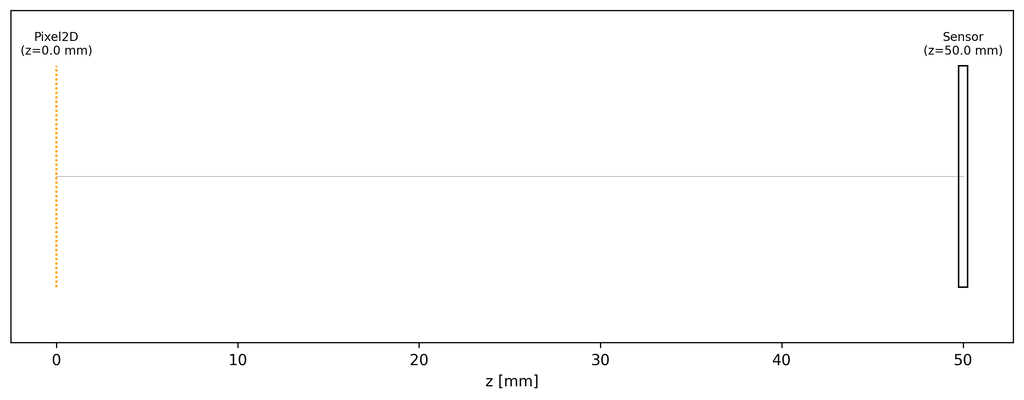
# 5 mm-aperture Pixel2D DOE at 2 µm pitch, sensor 50 mm behind (f/10).
lens = DiffractiveLens(filename="./datasets/lenses/diffraclens/pixel2d.json",
                       device="cuda", dtype=torch.float64)
optimizer = lens.get_optimizer(lr=0.1)
loss_fn = PSFStrehlLoss()  # maximize the on-axis center-pixel intensity

on_axis_inf = [0.0, 0.0, float("-inf")]
for _ in range(1000):
    psf = lens.psf(points=on_axis_inf)               # full sensor-resolution PSF
    strehl = loss_fn(psf.unsqueeze(0).repeat(3, 1, 1))  # expects RGB [3, ks, ks]
    loss = -strehl                                   # maximize -> minimize negative
    optimizer.zero_grad(); loss.backward(); optimizer.step()
Sampling rule
To focus the full aperture, the marginal-ray spatial frequency
(D/2)/(λf) must stay below the grid Nyquist 1/(2·ps). At f=50 mm,
D=5 mm, λ=0.55 µm, a 2 µm pitch keeps 91 cyc/mm well below the
250 cyc/mm Nyquist, giving a diffraction-limited spot λf/D ≈ 5.5 µm.
Results
Initial (random phase)
| Phase (init) | PSF (init) |
|---|---|
 |
 |
Optimized
| Phase (final) | PSF (final) |
|---|---|
 |
 |
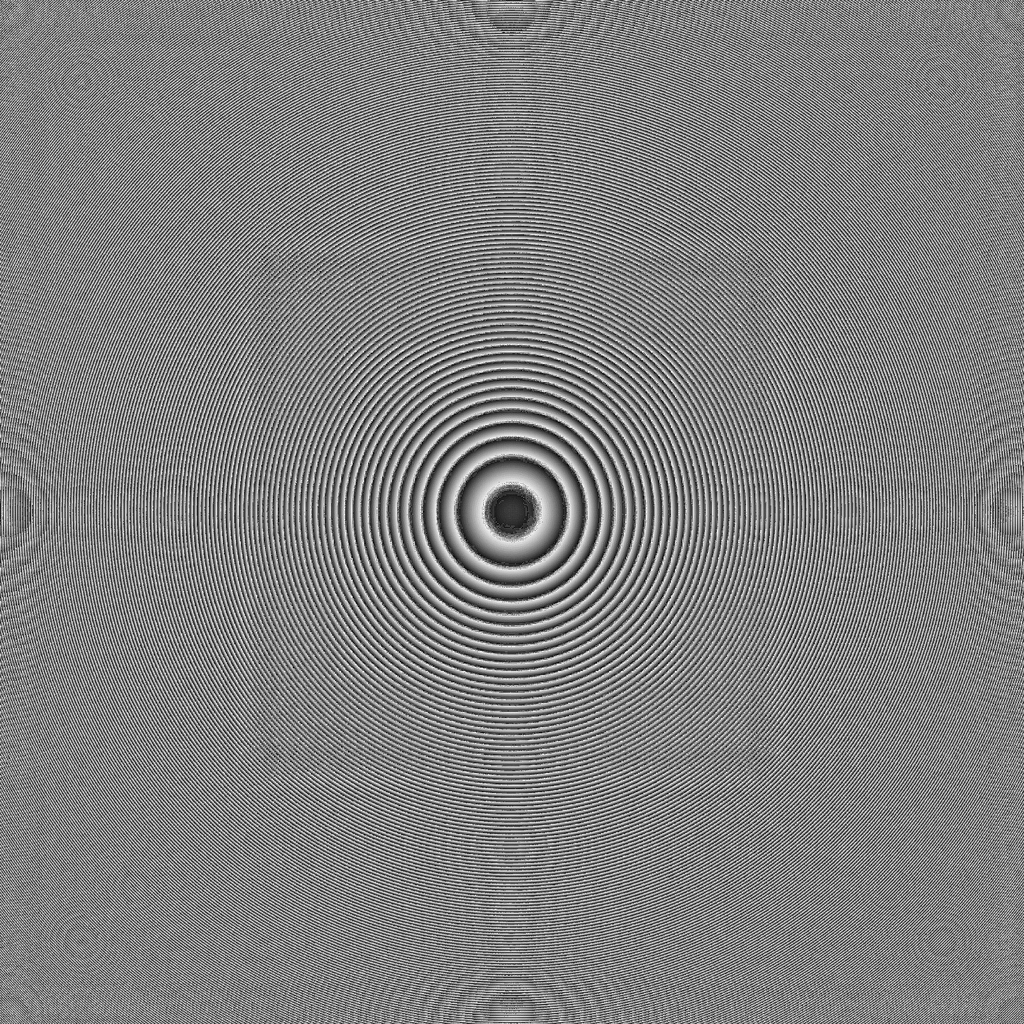
The random phase converges to a clean Fresnel zone plate and the diffuse field collapses to a sharp central peak.
Layout